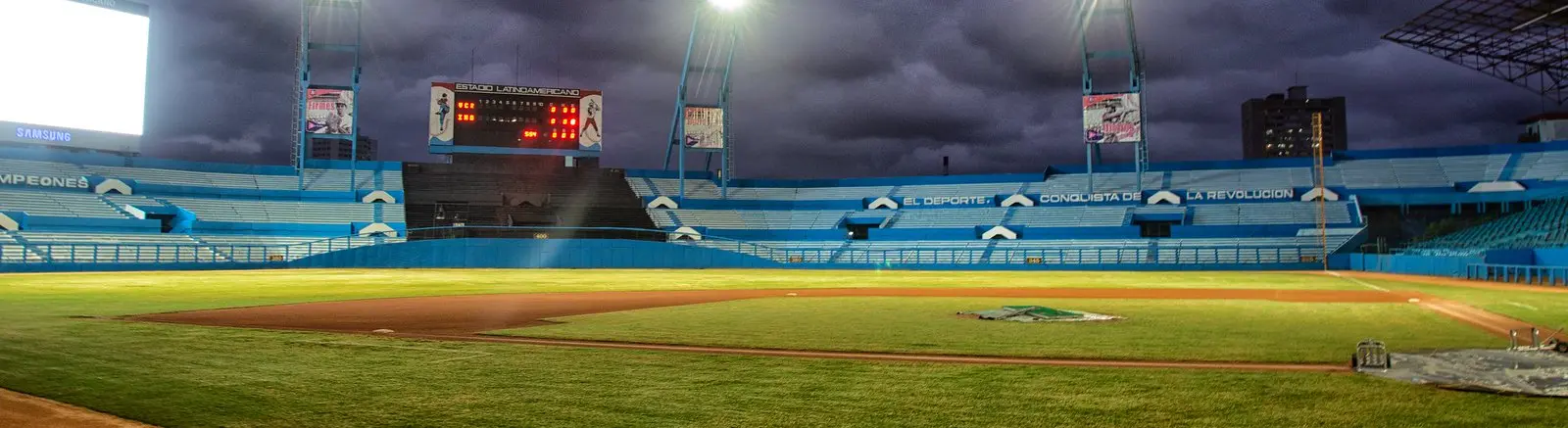


Every Cuban who has played in the major leagues since 1911 got there through a door the Cincinnati Reds opened. On 4 July that year Rafael Almeida and Armando Marsans took the field for Cincinnati, the first Cubans in the modern major leagues, and the club spent the following weeks explaining why that was allowed.
Thirty-four Cuban-born players have worn a Reds uniform since. The franchise gave Cuba its first major leaguers, its first star, its first 20-game winner and a Hall of Famer — and in 2026 it has none at all.
| Player | Pos | Born | Reds seasons | With the Reds |
|---|---|---|---|---|
| Armando Marsans | OF | Matanzas | 1911–14 | 322 G, .300, 1 HR, 109 RBI |
| Rafael Almeida | 3B | Havana | 1911–13 | 102 G, .270, 3 HR, 46 RBI |
| Mike González | C | Havana | 1914 | 95 G, .233, 0 HR, 10 RBI |
| Manuel Cueto | OF | Guanajay | 1917–19 | 132 G, .244, 1 HR, 29 RBI |
| Dolf Luque | P | Havana | 1918–29 | 395 G, 154–152, 3.09 ERA |
| Pedro Dibut | P | Cienfuegos | 1924–25 | 8 G, 3–0, 2.73 ERA |
| Tomás de la Cruz | P | Marianao | 1944 | 34 G, 9–9, 3.25 ERA |
| Raúl Sánchez | P | Marianao | 1957, 1960 | 46 G, 4–2, 4.84 ERA |
| Vicente Amor | P | Havana | 1957 | 9 G, 1–2, 5.98 ERA |
| Danny Morejón | OF | Havana | 1958 | 12 G, .192, 0 HR, 1 RBI |
| Orlando Peña | P | Victoria de las Tunas | 1958–60 | 59 G, 6–10, 4.27 ERA |
| Mike Cuéllar | P | Las Villas | 1959 | 2 G, 0–0, 15.75 ERA |
| Joe Azcue | C | Cienfuegos | 1960 | 14 G, .097, 0 HR, 3 RBI |
| Leo Cárdenas | SS | Matanzas | 1960–68 | 1,157 G, .261, 72 HR, 413 RBI |
| Rogelio Álvarez | 1B | Pinar del Río | 1960, 1962 | 17 G, .189, 0 HR, 2 RBI |
| Tony González | OF | Central Cunagua | 1960 | 39 G, .212, 3 HR, 14 RBI |
| Cookie Rojas | 2B | Havana | 1962 | 39 G, .221, 0 HR, 6 RBI |
| Chico Ruiz | 2B | Santo Domingo | 1964–69 | 466 G, .239, 2 HR, 57 RBI |
| Tony Pérez | 1B | Camagüey | 1964–76, 1984–86 | 1,948 G, .283, 287 HR, 1192 RBI |
| Camilo Pascual | P | Havana | 1969 | 5 G, 0–0, 8.87 ERA |
| Miguel de la Hoz | PH | Havana | 1969 | 1 G, .000, 0 HR, 0 RBI |
| Pedro Ramos | P | Pinar del Río | 1969 | 38 G, 4–3, 5.17 ERA |
| Tony Menéndez | P | Havana | 1992 | 3 G, 1–0, 2.14 ERA |
| Osvaldo Fernández | P | Holguín | 2000–01 | 35 G, 9–9, 5.29 ERA |
| Aroldis Chapman | P | Holguín | 2010–15 | 324 G, 19–20, 2.18 ERA |
| Yonder Alonso | 1B | Havana | 2010–11 | 69 G, .299, 5 HR, 18 RBI |
| Brayan Peña | C | Havana | 2014–15 | 223 G, .263, 5 HR, 44 RBI |
| Raisel Iglesias | P | Isla de la Juventud | 2015–20 | 274 G, 18–32, 3.15 ERA |
| José Iglesias | SS | Havana | 2019 | 146 G, .288, 11 HR, 59 RBI |
| Yasiel Puig | RF | Cienfuegos | 2019 | 100 G, .252, 22 HR, 61 RBI |
| José Barrero | SS | Havana | 2020–23 | 139 G, .186, 4 HR, 32 RBI |
| Cionel Pérez | P | Matanzas | 2021 | 25 G, 1–2, 6.38 ERA |
| Vladimir Gutiérrez | P | Havana | 2021–22 | 32 G, 10–12, 5.45 ERA |
| Yosver Zulueta | P | Remedios | 2024–25 | 19 G, 1–0, 5.43 ERA |
In the organisation now
No Cuban-born player is on the Reds’ major league roster in 2026. One is in the system: Alexander Vargas, a shortstop born in Matanzas in 2001, with Double-A Chattanooga. The last Cuban to appear for the club was Yosver Zulueta, whose nineteen relief outings ended in 2025.
The club that opened the door, 1911–1929
Frank Bancroft, the Reds’ secretary, had watched Almeida and Marsans play against Cincinnati in exhibition games in Cuba in 1908. The club bought their contracts on 28 June 1911 and they debuted six days later.
The colour line made this a problem that had to be managed. Cincinnati’s public defence was that the two men were entirely of European descent — in the club’s own phrase, “two of the purest bars of Castilian soap ever floated to these shores.” Both had played for the All Cubans, a touring Black club, six years earlier. The first two Cubans in the National League were admitted as white men, and the sorting of Cuban players by complexion that followed lasted another four decades — on this franchise and on every other.
Armando Marsans, outfielder, 1911–14
The better of the two, and briefly a star: .317 with 35 stolen bases in 1912, .297 with 37 in 1913, and a .300 average across 322 Reds games. He jumped to the Federal League in 1914 and his career never recovered. He later managed in the Cuban and Mexican leagues and was elected to the Cuban Baseball Hall of Fame in 1939.
Rafael Almeida, third baseman, 1911–13
102 games, a .270 average, three home runs. A bigger name in Havana than in Cincinnati, and the other half of the pair whose arrival is the reason this list exists.
Mike González, catcher, 1914
Ninety-five games in a Reds uniform and a long career elsewhere — and then something more significant: he became the first Latin American to manage a major league team, running the St. Louis Cardinals on an interim basis in 1938 and again in 1940. The scouting shorthand “good field, no hit” is attributed to him.
Dolf Luque, pitcher, 1918–29
The first Cuban star in the major leagues, and still the most successful Cuban in this franchise’s history: 395 games and 154 wins for Cincinnati. In 1923 he went 27–8 with a 1.93 earned run average and six shutouts, leading the National League in all three. He pitched for the Reds through his thirties on teams that mostly could not hit, finishing 154–152 for them, and, at 43, won the deciding game of the 1933 World Series in relief for the Giants.
Manuel Cueto (132 games, 1917–19) and Pedro Dibut (eight appearances, 3–0, 1924–25) complete the era. Then Cincinnati signed no Cuban at all for fifteen years.
The Havana pipeline and Tony Pérez, 1944–1969
Sixteen Cubans reached Cincinnati between 1944 and 1969, most of them in a cluster between 1957 and 1964 as every club in baseball worked the island at once. What makes the Reds’ version of that period unusual is how much of it they let go.
Mike Cuéllar pitched two games for Cincinnati in 1959 and won a Cy Young Award for Baltimore ten years later. Cookie Rojas played 39 games for the Reds in 1962 and made five All-Star teams for the Phillies and Royals. Tony González played 39 games in 1960 and hit .286 over twelve seasons after they traded him. Joe Azcue went 3-for-31 in 1960 and caught for a decade elsewhere. Four Cubans who became good major leaguers passed through Cincinnati and were gone within a season. Two stayed.
Leo Cárdenas, shortstop, 1960–68
Nine seasons, 1,157 games, four All-Star selections and a Gold Glove in 1965. He was the Reds’ everyday shortstop through the whole of the decade before the Big Red Machine assembled, and he went to Minnesota in 1969 — where he appears on the Senators and Twins list as well.
Tony Pérez, first baseman, 1964–76, 1984–86
The most important Cuban in the history of the franchise, and the only one in the Hall of Fame. Sixteen seasons in Cincinnati across two spells: 1,948 games, a .283 average, 287 home runs, 1,192 runs batted in, seven All-Star selections, and the middle of the order on the Big Red Machine teams that won the World Series in 1975 and 1976.
He was Most Valuable Player of the 1967 All-Star Game, the fifteen-inning one, which he ended with a home run in the top of the fifteenth. He was elected to the Hall of Fame in 2000 — the second Cuban-born player to be inducted, after Martín Dihigo.
Chico Ruiz, infielder, 1964–69
466 games as a utility infielder, a .239 average, and one play that outlived all of it: on 21 September 1964 he stole home against the Phillies in a scoreless game with two out and Frank Robinson at the plate. Philadelphia lost that night and nine more in a row, and blew a six-and-a-half game lead with twelve to play. It is still called the Curse of Chico Ruiz in Philadelphia.
The rest of the era is in the table. Camilo Pascual and Pedro Ramos, both of them Washington’s for a decade, closed out their careers in Cincinnati in 1969; Tomás de la Cruz went 9–9 in the wartime season of 1944; Orlando Peña, Raúl Sánchez, Vicente Amor, Danny Morejón, Rogelio Álvarez and Miguel de la Hoz account for the remainder.
Twenty-two years, and then the defectors, 1992 to now
Miguel de la Hoz batted once for Cincinnati in 1969. The next Cuban-born player to debut for the Reds did so in 1992 — twenty-two years later, and only because Tony Pérez’s second spell papered over the middle of the gap.
What reopened it was not scouting. Every Cuban on this list from 1992 onward left Cuba illegally or was raised outside it, and the two who mattered most arrived by the same route within five years of each other.
Aroldis Chapman, pitcher, 2010–15
He walked out of the Cuban national team’s hotel in Rotterdam in July 2009, took provisional residency in Andorra, and signed with Cincinnati in January 2010 for six years and $30.25 million — at the time a startling figure for a 21-year-old who had never pitched professionally outside Cuba.
On 24 September 2010, in his first month in the majors, he threw a pitch to Tony Gwynn Jr. at Petco Park that was clocked at 105.1 mph — later recalibrated to 105.8 — the fastest pitch ever recorded. Six seasons in Cincinnati: 324 games, a 2.18 earned run average, four consecutive All-Star selections from 2012 to 2015.
Raisel Iglesias, pitcher, 2015–20
From Isla de la Juventud, signed out of Cuba in 2014 as a starter and converted to closing. 274 games across six seasons, a 3.15 earned run average, and the club’s primary closer for four of them. Traded to the Angels after 2020.
Yasiel Puig, right fielder, 2019
One hundred games in Cincinnati after the Dodgers traded him — 22 home runs, a .252 average — and then a mid-season move to Cleveland. He left Cuba in 2012 on the seventh attempt, in a story that is among the most documented departures in the whole of this subject.
José Iglesias, shortstop, 2019
A one-year contract, 146 games, .288 with 11 home runs — comfortably his best offensive season to that point. Havana-born, he defected in Canada in 2008 during a junior tournament.
Brayan Peña, catcher, 2014–15
Two seasons and 223 games as a back-up catcher, a .263 average. He left Cuba as a teenager in 1999, while travelling with a junior national team.
José Barrero, shortstop, 2020–23
Signed out of Cuba in 2017 and for a time rated among the club’s best prospects, he never hit in the majors: .186 across 139 games in four seasons. The clearest case on this page of the modern gap between what a Cuban signing costs and what it returns.
The rest: Tony Menéndez (three appearances, 1992), Osvaldo Fernández (35 games, 2000–01), Yonder Alonso (69 games, 2010–11, before the trade that brought Mat Latos), Cionel Pérez (2021), Vladimir Gutiérrez (32 starts, 2021–22) and Yosver Zulueta (2024–25).
Cincinnati gave Cuban baseball its way into the major leagues, and it did so by arguing that the two men in question were white. Everything on this list follows from that afternoon in July 1911 — the pipeline, the sorting by complexion, Luque, Pérez, Chapman. The club that opened the door now has one Cuban in its entire organisation, and he is in Double-A.
The rest of the series
Cuba Dugout keeps a page like this one for every franchise with a real Cuban history: Chicago White Sox, Washington Senators and Minnesota Twins, New York Yankees, Miami Marlins, Detroit Tigers and Houston Astros. For the players active right now, see Cubans in MLB 2026. Every one of these lists is drawn from the Cuban Major Leaguers Database — all 403 Cuban-born major leaguers, searchable and downloadable.
Spotted an error in this article? Let us know and we'll correct it.
