

I was introduced to Major League Baseball in (Year redacted) the Mid 1980s. Those of a similar vintage came of age as fantastic athletes such as Darryl Strawberry, Deion Sanders, Bo Jackson and Ken Griffey Jr. captivated with style and feats perhaps not seen before. Despite this each carries an aura of what if. All still had immense success, but What could have been if not for injuries and other sporting commitments? There is Another player I believe that belongs in that pantheon. I also believe that Luis Robert is Spanish for Eric Davis.
It might seem odd asking what if about a player that spent 17 years in the Big Leagues. Injuries unfortunately prevented Davis from reaching his ceiling. But in small samples we saw some of the greatest athletic tools ever. Luis Robert might possess as many tools as this often overlooked dynamic talent.
Davis was a lithe outfielder who when healthy covered more of the earth than seawater in centre field. At 6’2 165lbs comparisons to Darryl Strawberry were inevitable. They were High School rivals and became friends in Los Angeles. Strawberry broke onto the scene in 1983 winning the Rookie of the Year award with The Mets. Davis debuted soon after in 1984 with Cincinnati. ‘Eric the Red’ as he was dubbed took a few years to cement himself. By age 24 he was running neck and neck with Strawberry as the top young star in the game. Davis’ 1986 season is one of the most unique ever. His .277/.378/.523 slash line is impressive for such a young player. Davis’ 27 HR and 80 RBI is perhaps the most ridiculous power and speed output we have seen.
1987 was generally better with his average climbing to .293 with 37 Home Runs and 100 RBI in 129 games. Davis missed time with small dings, foreshadowing what would be the through line of his career. He would never play more than 135 games in a season. In fact he only eclipsed 100 plus games in 9 of his 17 MLB seasons. During a 162 game stretch from 1986 to 1987 though he slashed .308/.406/.622 with 47 home runs, 123 RBI’s and 98 Stolen bases vs 12 caught stealing. A healthier Davis might have become the first 40/40 player with some speculating that 50/50 could be possible.

This brings us to the best athletic prospect if not of his generation at least to come out of Cuba. A player who similarly to Davis busted onto the scene as a high schooler except Luis Robert was excelling in Cuba’s top “professional” League. Robert stands 6’2 like Davis but likely last weighed 165 lbs when he was 16 years old. The two players though play the outfield and the game overall with an athletic ease seldom seen.
Luis Robert might prove to be the last true free agent signing to come out of Cuba as International rules changed soon after The White Sox inked him. The Pale Hose signed him for $26 million and were willing to pay an equal tax penalty and subsequently gave him the largest extension to a player who had yet had an MLB at bat. This would see him debut at 22, similar to Davis. Robert show flashes but slightly underachieved in his 2020 rookie season. Impressively he did take home the Gold Glove in Center Field, not a common occurrence for a rookie.
2021 saw The White Sox enter the season with high expectations for the first time in a decade. This took some of the pressure off of Robert. Unfortunately Robert did his best Eric Davis impression in missing the majority of the season with a torn hip flexor. However, again like Davis he bounced back and upon his return played like the most talented if not best player in the game.
As of this writing Robert has played in 132 career games, a slightly arbitrary number but one that aligns with Davis healthiest seasons. Relax your eyes and you might think you were looking at Eric Davis’ baseball reference page. .289/.339/.507 26 Home Runs 77 RBI 20 steals vs 3 caught stealing. That rare mix of power, speed and general athletic elegance is tantalizing.

Hopefully for Robert, White Sox fans and anybody who enjoys watching the game 2021’s injury proves fluke. Some might think that comparing him to a player that chronically battled to stay on the field is a curse onto itself. Again, Davis still had an impressive career, it just lags in comparison to his trajectory after five seasons in The Show. I truly do believe though that Robert has the type of talent that Eric Davis did. Even if Robert becomes as familiar with the Injured list, he will still be a game changer when he steps between the lines.
If Luis Robert is Spanish for Eric Davis we could be witnessing the future of the game. We should all be praying for health and for him to get the chance to pursue some of the marks that Davis was prevented from due to his body not cooperating. In a worse scenario if Robert is merely able to match Davis’ peak and or overall longevity the game is still in a better place.
Where the photographs come from
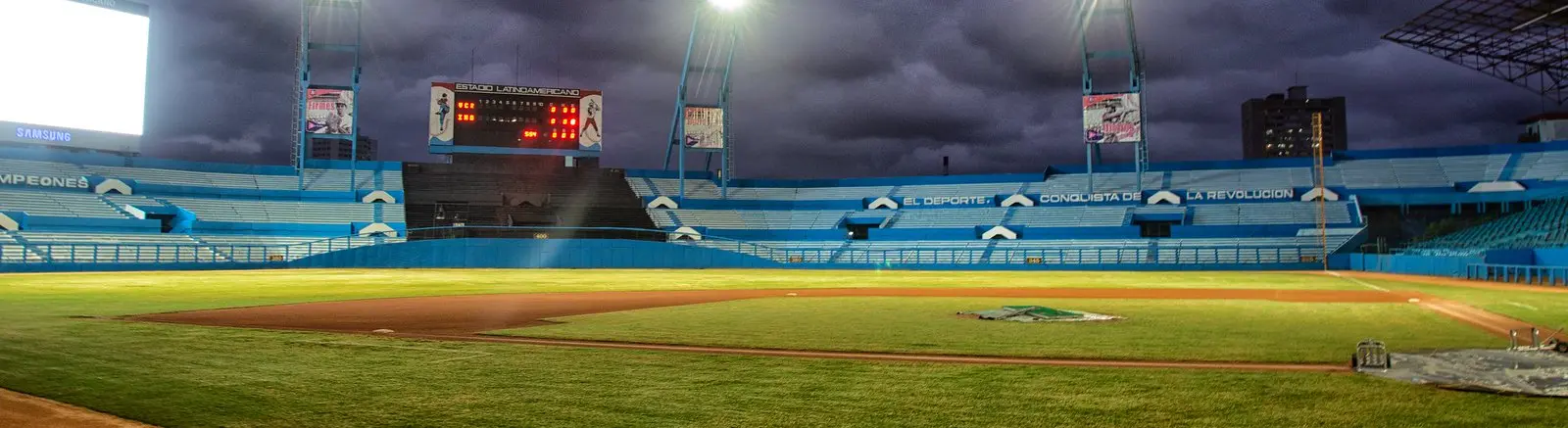
These pictures were taken in 2016, when the Cuban national team was playing a schedule in the independent Can-Am League — an arrangement that ran in 2016, 2017 and again in 2019, whose games counted in the league standings. Robert was 18, wearing number 9 for Cuba, and hit .286 in 16 Can-Am games. It is the last body of work anyone has of him as a Cuban player. He left the country later that year.


From Ciego de Ávila to a $26 million bonus
Robert came up with Ciego de Ávila and played four Serie Nacional seasons, the last of them — 2016–17 — a .401 average that led the league in on-base and slugging. He left Cuba around the turn of 2017, was declared a free agent that April, and signed with the Chicago White Sox in May 2017. The bonus is reported as $25–26 million; sources differ on the exact figure and the exact signing date.
Then came 2019, the season that made him a top-five prospect in baseball: he hit .328 with more than 30 home runs and 36 stolen bases across High-A, Double-A and Triple-A, led the minor leagues in hits, and was named MLB Pipeline’s Hitter of the Year.
The Major League career, year by year
| Year | Team | G | AVG | HR | RBI | SB |
|---|---|---|---|---|---|---|
| 2020 | White Sox | 56 | .233 | 11 | 31 | 9 |
| 2021 | White Sox | 68 | .338 | 13 | 43 | 6 |
| 2022 | White Sox | 98 | .284 | 12 | 56 | 11 |
| 2023 | White Sox | 145 | .264 | 38 | 80 | 20 |
| 2024 | White Sox | 100 | .224 | 14 | 35 | 23 |
| 2025 | White Sox | 110 | .223 | 14 | 53 | 33 |
| 2026 | Mets → Orioles | 58 | .223 | 10 | 23 | 2 |
| Career | 635 | .257 | 112 | 321 | 104 |
He won a Gold Glove in 2020 as a rookie and finished second in Rookie of the Year voting. His one great season is 2023: an All-Star selection, a Silver Slugger, 38 home runs and 12th place in the MVP vote. He has not been an All-Star in any other year.
The injuries, and the Eric Davis comparison
The comparison this article was built on has held up, and not in the way anyone wanted. Robert has been on the injured list nearly every season: a torn right hip flexor in 2021 that cost him three months, a wrist sprain that ended 2022, a Grade 2 hip flexor strain in 2024, a hamstring strain in 2025, and a herniated lumbar disc in 2026 that kept him out from late April until 20 July. One tally has him missing 36% of his team’s games between 2021 and 2023. Even 2023 — the All-Star year — included six separate injury interruptions. He played 145 games anyway.

Traded to the Mets
The White Sox picked up his $20 million club option for 2026 in November 2025 and then traded him. On 20 January 2026 he went to the New York Mets for infielder Luisangel Acuña and right-handed pitching prospect Truman Pauley. The Mets held a further $20 million option for 2027 with a $2 million buyout.
He was widely expected to move again at the August 2026 deadline as a rental. He was not moved then — but he did not finish the season a Met either. On 22 August he went back to Rate Field for the second time since the trade and hit two home runs against his old club.
Claimed, one day before the deadline
He is now an Oriole. On 31 August 2026 — one day inside the cutoff for postseason eligibility — Baltimore claimed Robert off outright waivers from the Mets, taking on the roughly $3 million left on his 2026 salary along with the $20 million club option for 2027 and its $2 million buyout. New York had put him on waivers rather than carry that money and the luxury-tax penalty attached to it, and to open at-bats for younger outfielders. It is his third organisation in eight months.
The timing is the whole story. A player has to be in an organisation before 1 September to be eligible for the postseason, and Baltimore claimed him on 31 August. Whatever Robert is now, he was worth a claim to a club that wanted another bat available in October.
He had also just started hitting again. Robert lost nearly three months to a herniated lumbar disc, going on the injured list in late April and not returning until 20 July, and his season line stayed ugly — .223 with 10 home runs and a .702 OPS in 58 games. But from 6 August onward he hit .288 with six home runs and a .922 OPS across 21 games, and on 22 August he went back to Rate Field and hit two home runs against the club that signed him out of Cuba. The Orioles are not buying the season. They are buying the last three weeks.
Set that against the four seasons in Ciego de Ávila above — the .401 and the league-leading on-base and slugging marks in 2016–17, at nineteen, in the months before he left. Ten years separate the teenager Cuba could not keep and the outfielder claimed off a waiver wire for the price of a month’s rent on a contract. Both are the same player, and the distance between them is what a decade of injuries does to a body that was once the second-best amateur prospect on earth behind Shohei Ohtani.
More on Cuban baseball
- Yoelqui Céspedes, who left the same touring team three years later
- Team Cuba: the national team’s full record
- How Cuban baseball is organised, and how players get out
- All 16 Serie Nacional teams
- When Cuba played North America: the Can-Am League years
Spotted an error in this article? Let us know and we'll correct it.
