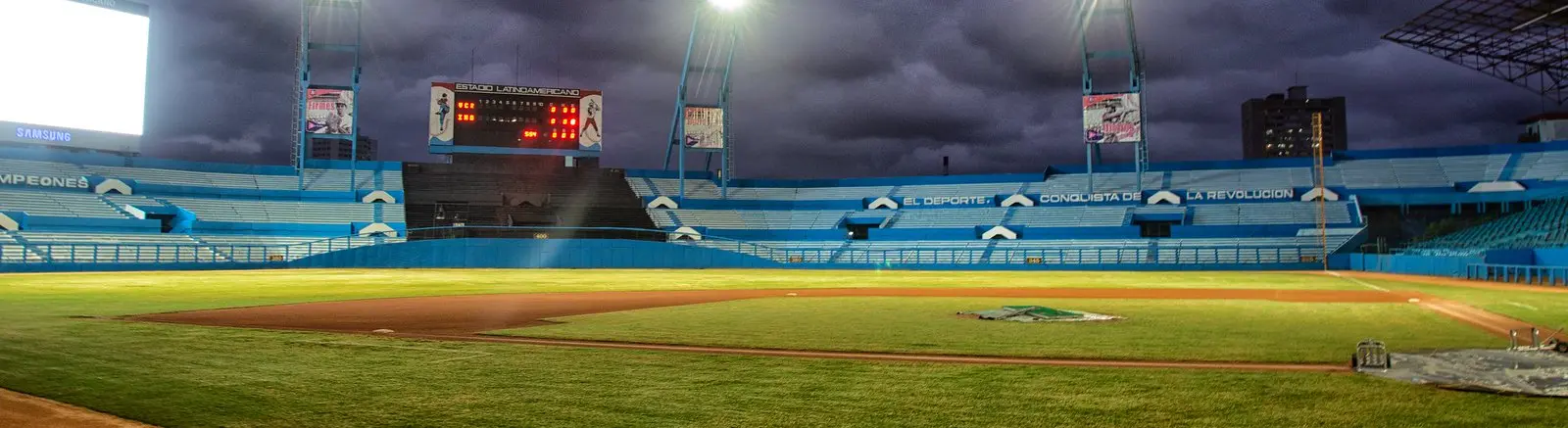


For three summers, Cuba’s national baseball team went on the road in North America and played for points. Not exhibitions — real games, in a real league, that counted in the standings. They had no home ballpark. They travelled between Quebec City, Ottawa, Trois-Rivières and three towns in New York and New Jersey, and they played the Can-Am League’s six clubs over and over.
It was the most open thing Cuban baseball had done in half a century, and it is barely written about in English. These photographs are from those tours.

How it started: one player, three days’ notice
The door opened in 2014, and it opened for one man. Yuniesky Gurriel — the eldest of the three Gurriel brothers — debuted for the Québec Capitales on 24 July 2014, the first Cuban player the government had ever released to a professional club in North America. The Capitales’ president had three days’ notice to fly to Havana and close it, capping roughly five years of quiet negotiation.

Two years later the whole national team came. The arrangement was negotiated between Heriberto Suárez, president of the Cuban Baseball Federation, and Miles Wolff, the Can-Am commissioner. Suárez called it evidence of “the excellent relations between Canada and Cuba” and a chance to get his hitters in front of better pitching before the 2017 World Baseball Classic. Wolff called it “sort of an educational experience” for both sides. The timing was not an accident: the United States had begun easing relations with Cuba in 2015, and for a moment it looked as though baseball would be the thing that walked through the gap.
2016: a good team, and an 18-year-old in centre field
Cuba played a 19-game itinerary in June 2016 and went 11–9 — a winning record against professional clubs, in a league they had never seen. Roger Machado managed. As a touring side they could not qualify for the playoffs, but the record was good enough that it would have put them fourth.
In centre field was an 18-year-old from Ciego de Ávila called Luis Robert. He hit .286 in 16 games. Alongside him were Julio Pablo Martínez, Guillermo Avilés, Lázaro Ramírez and the catcher Yosvany Alarcón, who led the team in hitting. Machado’s scouting report to a reporter that summer was blunt and, in hindsight, correct: “Robert and Martinez have speed and they can hit and they’re intelligent players, but Aviles has the power.”

The tour was not only baseball. The team visited the Yogi Berra Museum and ran a girls’ softball camp in New Jersey. “Baseball is the best thing Cuba has to offer,” Suárez said, “and we are grateful everyone here is supporting us.”
And on 24 June 2016, during a team shopping trip in New Jersey after the Sussex County series, the outfielder Lázaro Ramírez walked away from the delegation. He was the first to go.
Luis Robert stayed. He went home, finished a Serie Nacional season in which he hit .401, and left Cuba in November 2016 — months after the tour, not during it. He signed with the Chicago White Sox the following May.
2017: 5–16, and the night the umpires walked off
The second tour went badly. Cuba lost 16 of 21. Julio Pablo Martínez was in the league that summer, but not on that bus: his 2016 tour had earned him a contract of his own with the Aigles de Trois-Rivières, and he spent 2017 playing against the national team he had toured with the year before, hitting .297/.345/.449 for the Aigles. It was also his way out. And on the night of 29 June 2017, at Palisades Credit Union Park in Pomona, New York, the tour produced the only moment anyone outside the league remembers.
A Cuban runner was called safe at second. The umpires reversed it and called him out for interference. The Cuban bench erupted — dirt kicked at an umpire, chest-bumping, as many as seven members of the delegation surrounding a single official. There were ejections. In the end security escorted the entire umpiring crew off the field and the game was abandoned.
The runner at the centre of it was a 19-year-old outfielder named Yoelqui Céspedes. Remember him.

Martínez left Cuba that November, going to Haiti to establish residency and chase a Major League contract. Two tours, three departures — Ramírez, Robert, Martínez — and the second tour had ended with the officials being walked off their own field under escort.
2018: the year Cuba could not afford to come
There was no Cuban team in 2018. The reason given in Cuban reporting is not political and not diplomatic. The organisers could not cover the cost of getting the team there. The Dominican Republic toured instead.
That gap year is where the story turns, because of what happened off the field. On 19 December 2018, Major League Baseball, the players’ union and the Cuban Baseball Federation signed an agreement that would have let Cuban players sign with MLB clubs without leaving Cuba. Players aged 25 or over, or with six years of service, could be released; the federation would take 15–25% of the signing bonus. It was designed to end the smuggling networks that had moved Cuban players for two decades.
On 8 April 2019, the US administration voided it. A senior official called the arrangement itself a form of human trafficking, on the grounds that the federation is an arm of the Cuban state. MLB disagreed publicly. The deal was dead after under four months, and the only route out of Cuba was the old one again.
2019: the last tour, and the one that mattered
Cuba came back in June 2019. The stated purpose was preparation for the Pan American Games in Lima. Getting there was hard — Canada had suspended visa processing at its Havana embassy after the diplomat health incidents, and the squad only got their papers on 10 June. They flew out of Havana on the 12th and opened against the Ottawa Champions on 13–14 June 2019.
The delegation was 28 players under Rey Vicente Anglada. Frederich Cepeda was on it. So was Yoelkis Guibert. So was the catcher Frank Morejón. And so, for the second time, was Yoelqui Céspedes — now 21, and by then the most talked-about young hitter in Cuba.

On the night of 24–25 June 2019, during the New York and New Jersey leg, Céspedes left the team. Ten weeks earlier the legal route into Major League Baseball had been shut down in Washington. He did the thing the December agreement had been written to make unnecessary, because by June it was unnecessary to nobody.
He was declared a free agent in March 2020 as the number one international prospect in the world, signed with the White Sox for $2.05 million, and never played a Major League game. He was released in 2024. He is playing in the Mexican League now.
The three tours, in one table
| Year | Record | Notable players | Who left |
|---|---|---|---|
| 2016 | 11–9 | Luis Robert, Julio Pablo Martínez, Guillermo Avilés, Yosvany Alarcón | Lázaro Ramírez, during the tour, 24 June Luis Robert, that November |
| 2017 | 5–16 | Yoelqui Céspedes (Julio Pablo Martínez was in the league this season, but for Trois-Rivières, not Cuba) | Julio Pablo Martínez, that November — after a season with Trois-Rivières |
| 2018 | No Cuban team — the cost could not be covered | ||
| 2019 | Tour of all six clubs, June | Yoelqui Céspedes, Frederich Cepeda, Yoelkis Guibert, Frank Morejón | Yoelqui Céspedes, during the tour, night of 24–25 June |
What it was actually for
Read the arrangement from the Cuban side and it makes sense: competition the domestic league could no longer provide, in a country that could grant visas, at a moment when Washington seemed to be softening. Read it from the North American side and it makes sense too: a small independent league got a genuine national team and the attention that came with it.
Read it from the players’ side and it looks like something else entirely. For three summers, Cuba took its best young players — teenagers, mostly — and put them on buses inside the country most of them were eventually going to leave for. Four departures across three tours is not an epidemic. But Robert, Céspedes and Martínez were three of the most valuable prospects Cuba produced in that decade, and all three are gone. Robert signed for around $26 million. Céspedes was ranked the best international prospect alive.
The federation kept sending them anyway, and the reason is not mysterious. The alternative was worse: a domestic league losing players to smugglers instead, with nothing coming back at all.

What we do not know
Two things about these tours are genuinely unclear, and it is more useful to say so than to guess.
- Whether the players were paid. The 2018 MLB agreement had explicit terms — 15–25% of a signing bonus to the federation. Nothing comparable has been published about the Can-Am tours. Whether the players received wages, per diems, or nothing at all is not on the public record.
- Whether 2019 was the end. No source we can find announces a formal conclusion to the arrangement. The Can-Am League itself has since been absorbed into the Frontier League. Cuba has not been back that we know of, but nobody appears to have said out loud that it is over.
One further caution. A Canadian outlet reported at the time that Céspedes left in Dayton, Ohio, at a Can-Am “International Showcase”. Dayton is not a Can-Am city in any season, and no other outlet mentions it. We have not repeated it here.
Related
- Luis Robert Jr: Cuban career, stats and the Mets trade
- Yoelqui Céspedes: the best prospect in the world who never made it
- Yuniesky Gurriel: the eldest Gurriel brother
- Julio Pablo Martínez: the Can-Am star who made it — briefly
- Team Cuba: the national team’s full competition record
- How Cuban baseball is organised, and how players get out
Sources
Every date, score and departure in this piece comes from a published report. Where reports disagree, we have said so.
- Ballpark Digest, 7 March 2016 — the tour announced
- The Globe and Mail — Suárez and Wolff on the arrangement
- Seamheads, 24 July 2014 — Yuniesky Gurriel debuts for Québec
- MLB.com — the 2016 team on tour
- CiberCuba, 24 June 2016 — Lázaro Ramírez leaves the delegation
- CBS New York — the umpires escorted off at Pomona, 29 June 2017
- MLB Trade Rumors, November 2017 — Julio Pablo Martínez leaves Cuba
- CiberCuba, 29 January 2019 — Cuba to return to the Can-Am
- ADN Cuba — the 2019 visas and the 28-man delegation
- MLB.com — Yoelkis Céspedes leaves the Cuban team
- MLB.com, 19 December 2018 — the MLB–FCB agreement
- NPR, 8 April 2019 — the agreement is voided
Spotted an error in this article? Let us know and we'll correct it.
